The industrial aesthetic was born in New York lofts — empty factories where people lived amongst exposed brick and bare pipework simply because that was what they had. Now people do it on purpose. And a well-executed industrial style bathroom is one of the most distinctive looks you can go for: microcement, matt black and metal, with bags of character.
The tricky part is getting the balance right. Too much cold metal and grey, and instead of a loft you end up with a basement. Here’s how to stay on the right side of that line.
What defines an industrial style bathroom (and where the magic lies)
An industrial style bathroom revolves around three materials: cement or microcement on walls and floors, matt black on taps and trims, and exposed metal — usually steel or aged iron. Throw in some bare brick where space allows, and an Edison bulb or two hanging casually overhead, and you’ve got the bones of the look.
So far, so straightforward. The secret, though, is a single word: warmth. Pure industrial is hard, grey and a touch unwelcoming. Without something to break that chill, the bathroom ends up looking like a car park. That’s why we rarely recommend going full industrial; what genuinely works is an industrial look softened with wood, plants or textiles. In our experience, the industrial bathrooms our clients love most always have an oak shelf or a solid wood vanity unit cutting through all that grey.
The materials that define the look
Microcement — the undisputed king of this style. It’s the modern way to achieve that continuous concrete look without hundreds of grout lines. It works on walls, floors and even built-in shower trays. If you’re not already familiar with it, we break everything down — including costs — in our complete guide to microcement in bathrooms.
Matt black on every metal surface. Taps, shower screen frames, towel rails, mirror surrounds. Matt black is what pulls the whole look together. Key word: matt, not gloss. Shiny chrome kills the aesthetic instantly. Brands like Roca now offer entire ranges in matt black, so you won’t be short of options.
Metal with intention. A factory-style shower screen with a black grid frame, an iron towel rail, a metal frame for the basin. You don’t need to fill the room with ironwork — one or two strong pieces tell the story perfectly.
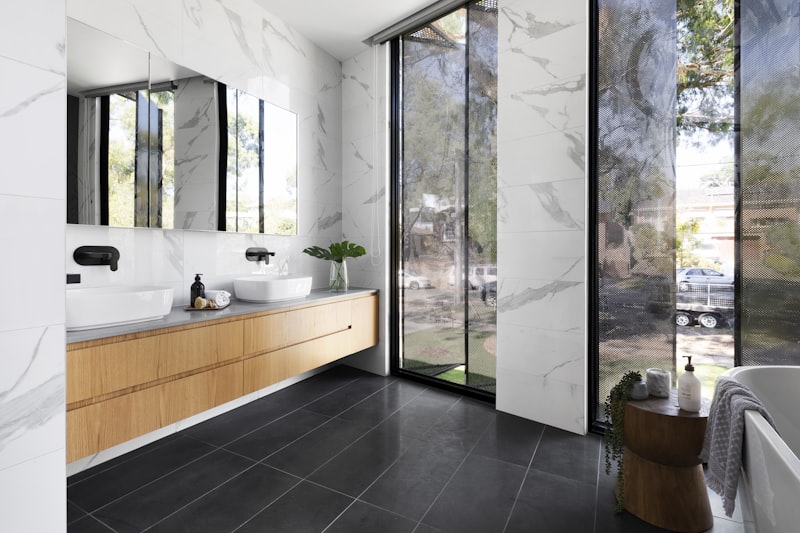
Wood, so it doesn’t look like a workshop. This is the saving grace. A solid wood vanity unit, a shelf, a stool. Wood brings the warmth that cement and metal strip away. Without it, the bathroom looks great in photos and feels cold in real life. If you’d rather use porcelain that mimics concrete instead of actual microcement, manufacturers like Porcelanosa have collections that replicate the look with a realism that would have been unthinkable a few years ago.
Exposed brick, if you’re lucky enough to have it. In older flats in Valencia — particularly in the Eixample and around Ruzafa — chipping back the plaster sometimes reveals beautiful solid brick underneath. If it appears, keep it and seal it. That’s genuine industrial, not imitation.
The colour palette: it’s not all grey
Industrial moves in greys and blacks, but it doesn’t have to feel monochrome and gloomy. The trick is in the warm accents.
| Base | Accents | Avoid |
|---|---|---|
| Cement grey, raw concrete | Natural wood (oak, walnut) | High-gloss white tiles |
| Matt black | Copper or aged brass | Shiny chrome |
| Exposed brick, terracotta | Green plants, leather | Pastel colours |
A copper or aged brass detail looks brilliant alongside black and grey — that warm note is exactly what stops everything feeling like pewter and ash. If you’re drawn to the darker side of things but want to explore other directions, have a look at how to work with dark-coloured bathrooms without getting it wrong: black, bottle green or navy blue all have their place.
How to pull it off in a real renovation (without it looking like a car park)
Let’s be honest about something. The industrial bathrooms you see on Pinterest are built in lofts with high ceilings and floor-to-ceiling windows. Your bathroom probably has 4 m² and a 2.5 m ceiling. The look is absolutely achievable — you just need to calibrate the doses carefully.
- Start with microcement. Walls and floor in continuous concrete give you 60% of the style in one go. In a small bathroom, the seamless finish also makes the space feel larger.
- Wood is non-negotiable. A solid wood vanity unit or shelf. Not optional — it’s what separates a welcoming bathroom from a car park.
- One standout metal piece. A factory-style shower screen or an iron towel rail. One, not ten.
- Get the lighting right. Edison bulbs or warm-toned spotlights (2,700–3,000 K). Surgical-white light over grey cement is a recipe for misery. Lighting does half the work in this style.
- One plant and you’re done. Green against grey works brilliantly. A pothos or a sansevieria will handle the humidity and low light of a bathroom without complaint.
If you’re still weighing up styles before committing, our guide to modern bathrooms by style puts industrial alongside minimalist, spa and japandi so you can compare them properly.
What does an industrial style bathroom cost?
Roughly the same as any mid-to-high quality renovation. Properly applied microcement isn’t cheap — it typically runs around €80–120/m² for materials and labour combined, based on industry data we’ve gathered for our guide — and quality matt black taps aren’t budget buys either. But it’s not an inherently expensive style: what pushes the cost up is the quality of the finish, not the style itself.
Where you can save is on the metal elements and brick: a standard black-frame shower screen costs barely more than a plain one, and exposed brick — if it’s already there — costs nothing. To get a realistic figure based on your actual square meterage and chosen finishes, use our renovation calculator and get an indicative number in a couple of minutes.
Who is this look for (and who should probably look elsewhere)?
Industrial suits people who want character, rawness and personality. People who are bored of the standard white bathroom and want something with more edge. People who live in a flat with some history and want to celebrate it rather than cover it up.
It’s less well suited to those after a light, airy Nordic feel, or anyone for whom the word “cement” conjures up an unfinished building site. For those profiles, there are gentler styles. One more thing to bear in mind: in a tiny bathroom with no natural light, going too dark with the industrial look can feel oppressive. In that case, ease right back on the black.
Frequently asked questions
Does an industrial bathroom feel cold or uncomfortable?
Only if you stop at cement and metal with nothing else. Add wood, a plant and warm lighting and the result is genuinely inviting. The key is not going “pure”: the industrial bathrooms people actually love always have a warm counterpoint.
Is microcement durable in the shower?
Yes, when it’s properly applied and sealed. It needs the right primer and two coats of water-repellent sealant. Applied badly, it stains and cracks — so the quality of the workmanship matters more than the material itself here. We cover this in detail in our microcement guide.
Does it work in a small bathroom?
It does, but you have to be thoughtful about it. Continuous microcement makes the space feel larger, which helps. What you need to control is the black: in a 4 m² bathroom, keep it to the taps and one accent detail — don’t go covering the walls. Too much dark in a small space becomes suffocating.
Will the industrial style date?
It’s been going strong for more than a decade with no signs of fading, largely because it draws on real materials — concrete, iron, wood — rather than a seasonal colour trend. It’s considerably more enduring than plenty of looks you see one year and never again the next.
Can I mix it with other styles?
Absolutely, and it often works better that way. Industrial combined with Scandinavian (more wood and white) softens the overall feel. Industrial with some handmade zellige tiles adds texture. The key is keeping microcement and matt black as the through-line, whatever you add around them.
The bottom line
An industrial style bathroom isn’t about recreating a mechanic’s workshop. It’s about honest cement, considered matt black and purposeful metal, finished with just enough wood and greenery to make it somewhere you actually want to be. Less is more: one strong metal piece, a well-applied microcement finish and an oak shelf will always beat ten industrial details piled on top of each other.
If you’ve been picturing it as you read, let’s talk it through. Browse some of our designs or tell us about your space and we’ll work out what’s possible together. At bathroom renovations in Valencia we’ve spent years refining this style — getting the character without the cold. Or drop us a line via contact and we’ll tell you exactly what can be done with your bathroom as it stands today.