Picture a three-year-old standing on tiptoe, gripping the edge of the sink, wet floor beneath them, straining to reach the tap. We’ve seen that scene in dozens of homes around Valencia, and it almost always ends the same way: either they can’t reach and shout for you, or they do reach and slip. The problem isn’t the child. It’s that the bathroom was designed for adults.
The best kids bathroom ideas aren’t about rubber ducks and cartoon tiles. A great children’s bathroom is one where a small child can wash their hands, use the loo and brush their teeth on their own — safely, without you hovering over them every second. That comes down to three things: proportions that work for their size, proper safety measures and a space they actually want to use. Let’s take them one by one.
Kids bathroom ideas: why children’s bathrooms need a different approach
An adult stands between 1.60 m and 1.85 m. A three-year-old is about a metre tall. Every tap, basin, mirror and light switch is at a height that’s simply out of reach for them. We tend to “solve” this with a little plastic step stool — but a step stool on a wet floor is exactly what you don’t want.
Domestic accidents involving children under four happen disproportionately in the bathroom. According to Spain’s National Statistics Institute (INE), falls and traumatic injuries remain one of the leading causes of unintentional harm in early childhood — and the bathroom packs two of the main risk factors into one small room: hard surfaces and slippery floors.
The good news is that designing with children in mind doesn’t mean building a “baby bathroom” you’ll have to gut in five years. It means being thoughtful about where things go and what materials you use underfoot. Those decisions work just as well when they’re teenagers.
The heights that actually matter
This is where 70% of the work lies. Below are the measurements we use when designing a bathroom for children aged 2 to 6. You don’t need to hit them to the millimetre, but they give you a reliable starting point.
| Element | Standard adult height | Comfortable height for young children |
|---|---|---|
| Basin (top edge) | 85–90 cm | 50–60 cm |
| Mirror (bottom edge) | 100–110 cm | 60 cm |
| Light switch | 110 cm | 80–90 cm |
| Towel rail | 120 cm | 70–80 cm |
| Toilet seat | 40 cm | reducer + step |
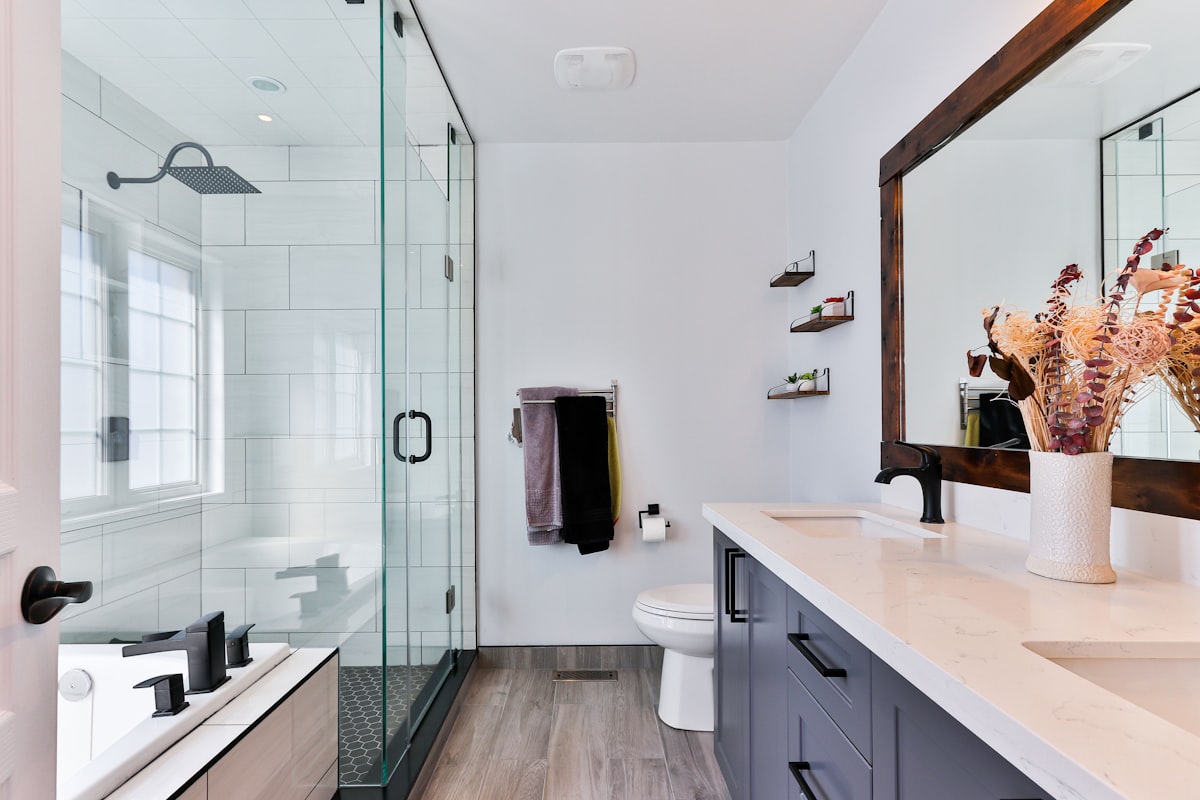
You don’t need to fit a miniature second basin. In a shared family bathroom, the practical solution is a standard-height basin with a wide, non-slip step or stool, a toilet reducer, and a low towel hook just for their towels. For a full breakdown of measurements by height, see our guide on bathrooms designed for different heights and needs.
Getting the step right
The wobbly plastic step stool is the enemy. What actually works is a wide step with a rubber base that won’t slide and won’t tip under a child’s weight. Some vanity units now come with a built-in pull-out step drawer: push it out with your foot, the child climbs up, push it back in. It’s one of the most useful things we’ve installed in family bathrooms in Valencia.
Safety: the details that prevent real accidents
Non-slip flooring — no debate
A child will always run out of the shower. Every time. No matter how many times you tell them not to. That’s why the floor comes first. Look for flooring with an anti-slip rating of Class 2 or 3 under Spain’s Technical Building Code (CTE, Safety in Use section) — the same standard that applies to public buildings. (For expat readers: the CTE is Spain’s national building regulations, roughly equivalent to UK Building Regulations Part K.) Inside the shower, that means a genuinely non-slip tray, not one that just says so on the packaging. We go into much more detail in our guide to non-slip shower trays.
Temperature control on the taps
Scalds from hot tap water are more common than most people realise, and a child’s skin is thinner and more sensitive than an adult’s. The fix is straightforward: a thermostatic tap with a built-in temperature limit, or a limiter on the boiler, set to a maximum of 38–40 °C. You set it once and forget about it.
Corners, locks and sockets
Rubber edge guards on the corners of vanity units are cheap and prevent a surprising number of nasty bumps. Bathroom sockets must have childproof covers and be positioned well away from water. And one detail that’s easy to overlook: make sure the bathroom door can’t be locked from the inside without a way to open it from outside. A small child locked in on their own, frightened, is a situation no one wants. For a complete checklist of bathroom safety measures, see our guide to preventing bathroom falls.
Making it a space they actually want to use
A child uses the bathroom independently when it’s easy and pleasant to do so. You don’t need to turn it into a theme park — just get a few things right.
- Everything within reach. Soap dispenser at their height, towel on a low hook, toothbrush and cup on a shelf they can actually access. The more independent they are, the less they call for you.
- Colour, used wisely. Children love colour, and a splash of it lifts the room — but go for neutral base tiles and bring colour in through things that are cheap to change: a painted wall, a border strip, the accessories. That way, when they grow up, you’re not stripping out the whole bathroom.
- Proper lighting. No child should have to walk into a dark bathroom. Warm, generous light as standard, with a soft night light for those late-night trips.
Our honest view, after many family bathroom renovations across Valencia: the most expensive mistake is designing “to last two years.” Children change fast. The right approach is a bathroom that’s safe and comfortable for them now, but that — with a swap of accessories — works just as well at twelve. The low-cost items are the removable ones: the step, the toilet reducer, the border tile. The expensive items — the floor, the shower tray, the taps — should be chosen with the long game in mind.
If you have more than one child, or want to think about the whole house, our guide on family bathrooms: safe and practical covers the broader picture. And our bathroom ergonomics guide has useful insights that apply to users of all ages.
A real example from Valencia
We recently renovated a bathroom in a flat in Benimaclet for a family with two children aged four and six. We didn’t touch the layout. What we changed: replaced the shower tray with a flush-to-floor non-slip model, fitted a vanity unit with a built-in pull-out step, installed a thermostatic tap with a 38 °C limit, and tiled one wall in a pale blue mosaic the kids absolutely loved. Everything else stayed neutral. The parents told us that within a week, both children were brushing their teeth on their own. That’s the measure of success — not the rubber ducks.
Frequently asked questions
How high should the basin be if the whole family shares the bathroom?
Keep it at the standard adult height (85–90 cm) and solve the height difference with a wide, non-slip step or a vanity unit with a built-in step drawer. It’s not worth lowering the basin — in two or three years it’ll be too short for them anyway.
How do I stop my child getting scalded by hot water?
Fit a thermostatic tap with a temperature cap, or a limiter on the boiler, set to a maximum of 38–40 °C. It’s the most effective measure available, and you only need to set it once.
Is it worth having a dedicated children’s bathroom?
If you have the space and a second bathroom, it can make sense. In most homes, the practical approach is to adapt the shared family bathroom with removable elements — a step, a toilet reducer, a low towel hook — rather than building a dedicated children’s bathroom that you’ll outgrow in a few years.
What’s the safest floor for a children’s bathroom?
Flooring rated Class 2 or 3 for slip resistance (for example, matt textured porcelain stoneware), and inside the shower, a genuinely non-slip tray. Avoid highly polished tiles: wet, they’re basically an ice rink.
How much does it cost to adapt a bathroom for children?
It depends on how much you’re changing. Swapping the shower tray, taps and vanity unit puts you in mid-range renovation territory; adding accessories alone costs very little. You can get a rough idea with our price calculator.
The goal is simple: they go in, do what they need, and come back out safely
A well-designed children’s bathroom shows itself in one very specific moment: the day your child walks in, does their thing and comes back out without calling for you. That’s it. They reach the tap, the floor doesn’t slip, the water doesn’t scald, and they’re happy to be there. You don’t need to renovate everything or cover the walls in cartoon characters. You need the right heights, materials that don’t slide, and a handful of safety details done properly.
If you’re thinking about adapting your bathroom for your children, tell us what you’ve got and we’ll tell you what to change and what to leave well alone. And if you’d like to see how we work, take a look at our bathroom renovations in Valencia.