You give the shower screen a good clean on Saturday. By Wednesday there’s that white film again. You polish the tap, it shines for a day, then it’s dull and streaky. If you live in Valencia — or anywhere on the Costa Blanca — this is not a reflection of how well you clean. It’s the water.
Limescale on taps and shower screens is, by a long way, the number-one maintenance complaint we hear across the Comunitat Valenciana. And it has a very specific physical explanation: our water is hard. Very hard. Every drop that dries on chrome or glass leaves behind a mineral residue, and that residue builds up layer by layer until it seems impossible to shift.
Why limescale attacks taps and shower screens in Valencia
Tap water contains dissolved calcium and magnesium. The more it contains, the “harder” the water. When the water evaporates, those minerals are left stuck to whatever surface it touched. That’s limescale.
Valencia’s water is particularly hard. According to water quality reports from Global Omnium (Aguas de Valencia), hardness across much of the metropolitan area runs between 40 and 50 French degrees (ºfH) — whereas water classified as “soft” sits below 15 ºfH. We’re talking about more than three times the threshold. That’s why kettles fur up within a month here and shower screens go cloudy within three days.
There are two places in the bathroom where it really shows:
- Taps, because the water splashes out and, as it dries, leaves spots on the chrome plating and — worse — gradually blocks the aerator (the little mesh filter on the end of the spout).
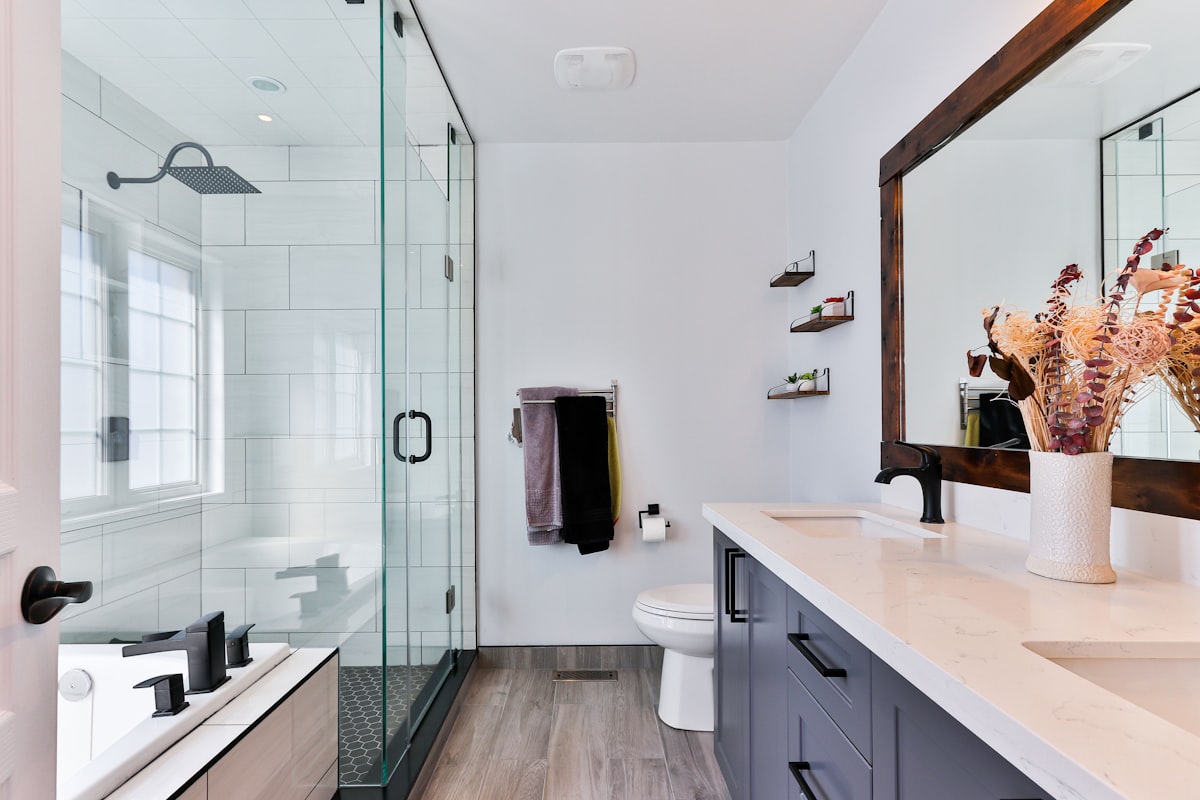
- The shower screen, because after every shower the glass is left wet, the water evaporates on the spot and leaves that white coating. If nobody runs a squeegee over it, within a week you can barely see through it.
Limescale isn’t just unsightly — it causes real damage
Here’s our honest take, after replacing hundreds of taps and fittings in Valencian flats: people massively underestimate how much limescale destroys from the inside. It’s not just about looks.
Limescale works its way into the tap aerator and reduces flow until the water comes out at a weird angle. It builds up inside the cartridge of a mixer tap until it becomes stiff to turn. In the shower head it blocks the spray holes one by one. And on glass, if you leave it for years, the limescale actually etches into the surface — leaving micropores where even more scale can grip — and at that point no amount of cleaning will fix it.
| Element | What limescale does | Fixable? |
|---|---|---|
| Tap chrome plating | White marks, loses shine | Yes — clean it |
| Aerator (tap end filter) | Reduced flow, wonky jet | Yes — unscrew and soak |
| Mixer tap cartridge | Stiff to turn, drips | Sometimes — otherwise replace |
| Shower head | Blocked spray holes | Yes — soak in vinegar |
| Shower screen glass | White film, then micropores | Yes at first — not once it’s etched |
How to remove limescale without wrecking anything
The best limescale solvent is already in your kitchen cupboard and costs next to nothing: white vinegar. Limescale is alkaline; vinegar is acidic — it dissolves it. But you need to use it sensibly.
On taps. Soak a cloth or piece of kitchen roll in white vinegar and wrap it around the tap. Leave it for 20–30 minutes, then rub with a soft cloth. For the aerator, unscrew it and drop it in a glass of vinegar for half an hour — you’ll see the white flakes come off on their own. Rinse well with water and dry.
On the shower screen. Mix equal parts vinegar and water in a spray bottle, spray it on, leave for five minutes and wipe with a microfibre cloth. If the scale is stubborn, repeat. You’ll find the full step-by-step in our guide on how to clean a shower screen and tray properly.
Three things you should never do — we see them far too often:
- No scourers or razor blades on the glass. They scratch the shower screen permanently, and scale grips even harder in scratches. Same goes for chrome: soft cloth only.
- Watch out with aggressive descaler sprays on chrome plating. Many contain strong acids that, if left too long, will pit the finish. Read the label and don’t leave them on longer than stated.
- Never mix vinegar and bleach. It produces toxic fumes. One or the other — never both together.
How to stop it coming back (this is the part that actually matters)
Removing limescale once is straightforward. The problem in Valencia is that it always comes back. The key is not giving it time to dry and bond:
- Squeegee after every shower. Yes, those 20 seconds with the squeegee on the glass is the single most effective trick there is — and the one most people skip. If the water doesn’t dry on the screen, barely any limescale forms.
- Treat the glass with a hydrophobic sealer. There are anti-limescale treatments for shower screens (nanoparticle-based coatings) that make water bead and run off rather than drying in place. They last months and make a noticeable difference.
- Dry the tap occasionally. A quick wipe after using the basin eliminates about 90% of water marks before they even form.
- And the root solution: a water softener. A unit fitted at the mains water inlet reduces hardness throughout the entire property. Not just the bathroom — the washing machine, the water heater and the kettle will all thank you too. It’s the investment we most often recommend to clients who are fed up with fighting limescale week in, week out.
When we carry out a complete bathroom renovation in Valencia, we build all of this in from the start: quality fittings, shower screens with factory anti-limescale treatment, and — if the client wants it — provision for fitting a water softener. Planning it up front is considerably cheaper than retrofitting it later.
Choose the right taps and shower screen (materials matter)
Not all taps stand up to limescale equally well. A quality chrome finish from a reputable brand holds up far better than a cheap one that starts pitting within a year. If you’re renovating, this is not the place to cut costs. We compare the main options in our Roca, Grohe and Tres tapware comparison — all brands whose finishes are specifically engineered for hard water like ours. Manufacturers like Roca have spent years developing coatings that actively repel limescale, precisely because water hardness is such a widespread issue in Spain.
The same logic applies to shower screens. Glass thickness and treatment make the difference between a screen you can wipe down in a minute and one you’re wrestling with every week. We explain what thickness to choose and why in our shower screen glass thickness guide. And if your bathroom also has damp or condensation problems, limescale is only half the story — take a look at our guide on the causes and solutions of bathroom damp.
If you’re thinking about a renovation and want to see finishes that cope better with Valencian water, have a browse through our bathroom designs — real projects, real results. And the quote calculator gives you a rough figure in a couple of minutes.
Frequently asked questions
Is Valencia’s water really one of the hardest in Spain?
It’s among the hardest, yes. Much of the metropolitan area registers 40–50 ºfH according to Global Omnium, compared with under 15 ºfH for soft water. That’s why limescale appears here so quickly — expats from northern Europe or the UK often find the difference dramatic compared to what they were used to at home.
Does vinegar damage tap fittings?
Not if you use it correctly: applied and rinsed off within 20–30 minutes, it’s safe for chrome plating. The problems come with strong proprietary descalers left on for hours, or from scrubbing with abrasive pads.
Is a water softener worth it just for the bathroom?
If your only complaint is the shower screen, there are cheaper solutions. But a softener benefits the whole property (washing machine, boiler, pipework), so if limescale is a general headache, yes — it’s worth it.
My shower screen is completely white and vinegar isn’t touching it — what do I do?
If scale has been building for years it may have etched into the glass, creating micropores. At that stage, normal cleaning won’t reach it. You can try a specialist glass polishing compound, but sometimes the most cost-effective answer is to replace the glass panel.
Can limescale completely block a tap?
Yes. The aerator and cartridge can become so obstructed that flow drops dramatically or the tap starts to drip. Dismantling and soaking usually sorts it, but if the cartridge is badly damaged it’ll need replacing.
In Valencia, with limescale, prevention wins every time
Here’s what actually works: squeegee the glass after every shower, wipe down the tap occasionally, use vinegar for regular maintenance — and if you’re done with the weekly battle, consider a water softener. That combination takes care of 90% of the problem.
And if you’re planning a renovation, choose your taps and shower screen wisely from the outset: it saves years of scrubbing. Want advice on which materials hold up best against Valencia’s water? Tell us about your bathroom and we’ll tell you what makes sense for your space and your budget.