The bathroom is the most dangerous room in your home. It’s not alarmism: the data confirms it.
This is the most important article on our blog. Because a safe bathroom isn’t a luxury — it’s a necessity. And because what we’re about to tell you here could prevent a 112 emergency call on a Sunday morning.
In a building on Avenida Blasco Ibanez, a client’s daughter called us on a Monday at 7 am. Her mother had slipped the previous Sunday afternoon getting out of the bathtub. She didn’t break anything — she was lucky — but the blow to her hip left her unable to walk for two weeks. Her daughter said something that stayed with us: “I wish I’d called you sooner.”
We’ve heard that phrase too many times. And that’s why we’re writing this: so you don’t have to say it.
The numbers nobody wants to hear
Let’s lay the data on the table, because this is no joke.
According to the World Health Organisation, falls are the second leading cause of death from accidental injuries worldwide. In Spain, data from the National Statistics Institute (INE) reveals an uncomfortable reality: 30% of domestic accidents in people over 65 occur in the bathroom. Thirty out of every hundred.
The most common type of accident is slipping while getting in or out of the bathtub. That absurd manoeuvre of lifting your leg 55 centimetres over a wet edge, with soapy feet and nothing to hold on to. We do it every day without thinking. Until one day it goes wrong.
The figures are stark:
- More than 5,000 elderly people are hospitalised each year in Spain from bathroom falls (estimated WHO/INE data).
- 70% of hip fractures in people over 80 occur at home, and the bathroom is the most frequent location.
- A hip fracture in a person over 75 has an associated mortality of 20-30% within the first year. Yes, you read that correctly.
These aren’t abstract numbers. They’re grandmothers who fall on a Sunday, grandfathers who break a femur on a Tuesday night. And in many of those cases, the fall could have been prevented with measures that cost less than a television.
The 8 anti-fall measures that truly work
We’ve been renovating bathrooms in Valencia and surrounding areas for 12 years. In that time we’ve seen everything: from 1970s bathrooms with cast-iron bathtubs and polished terrazzo floors (an ice rink when wet), to recently renovated bathrooms without a single grab bar.
These are the 8 measures we recommend. We’ve ordered them from highest to lowest impact, though ideally you’d combine several.
1. Genuinely non-slip flooring (classification C2 or C3)
Not just anything that says “non-slip” on the box will do. For wet areas like the shower, the floor needs a C2 classification at minimum, ideally C3 according to the DIN 51097 standard. This isn’t our whim: the Spanish Technical Building Code (CTE) requires it in its document DB-SUA (Safety of Use and Accessibility) for floors in areas where people walk barefoot with water.
How do you know if your floor meets the standard? If you step on it wet and barefoot and feel your foot gripping the surface without sliding, you’re fine. If you slip or feel your foot “floating,” you have a problem. Porcelain tiles with a “grip” or “outdoor” finish from manufacturers like Pamesa or Porcelanosa usually meet C2/C3. Polished terrazzo or vitrified tiles don’t come close.
Cost: Between €400 and €900 for the floor of a standard bathroom (materials + installation).
2. Grab bars in shower and by toilet
The cheapest, easiest to install measure — and the one that prevents the most accidents. Yet the one fewest people fit. Because grab bars carry a stigma: “that’s for hospitals,” “that’s for old people.” Let’s be clear: that’s for smart people.
A well-placed bar beside the shower and another by the toilet gives you a firm grip point when you need it. They must support at least 150 kg and be anchored to the wall with proper fixings — never suction cups.
| Type | Price | Recommended location |
|---|---|---|
| Fixed bar 60 cm | €30-80 | Shower side wall |
| Folding bar | €50-120 | Beside toilet |
| Corner bar | €40-90 | Shower corner |
| L-shaped grab rail | €60-130 | Shower entrance |
The Roca Access line has stainless steel bars that wouldn’t look out of place in any modern bathroom. This is no longer the white hospital tube of the 1990s.
3. Floor-level shower (zero step)
If you still have a bathtub, this is the most important change you can make. Eliminating the bathtub step (or the raised shower tray) removes the number one risk manoeuvre: lifting your leg over a wet edge.
A shower tray flush with the bathroom floor, with a 1-2% slope towards the drain, allows you to walk in without any obstacle. This is known as a “level-access shower” or “walk-in shower.”
We have a complete guide on switching from bathtub to shower where we explain the 8 real problems of keeping a bathtub. And if you want to see what a well-designed accessible bathroom looks like, check our Compact Wet Room design.
Cost: Between €1,800 and €3,500 for the complete bathtub-to-floor-level shower conversion. Calculate your budget with our configurator.
4. Shower seat (fixed or folding)
Showering standing up when you have balance issues, fatigue or dizziness is a risk. A shower seat allows you to shower sitting down in complete safety. There are two main options:
- Wall-mounted folding seat: folds away when not in use. Takes up very little space. Price: €80-200.
- Built-in masonry bench: forms part of the shower design. More robust and aesthetically pleasing. Price: €300-600.
If you’d like to learn more, we have a complete article on showers with seats: types and installation.
5. Good lighting (no dark corners)
Accidents increase when you can’t see where you’re stepping. It’s that simple. An accessible bathroom needs at least 300 lux of general lighting and a specific light point in the shower area (an LED downlight with IP65 water protection).
No burnt-out bulbs that you’ll “change tomorrow” and no dim mood lighting that looks nice but illuminates nothing. And a practical tip: fit a switch with a pilot light or a motion sensor for nighttime bathroom visits. At 3 am, searching for a switch in the dark on a wet floor is an accident waiting to happen.
Cost: Between €200 and €600 for proper bathroom lighting with a shower light included.
6. Contrast strips on edges and steps
If there’s any level change in your bathroom (shower step, tray edge, floor level change), a visual and tactile contrast strip reduces the risk of tripping. These are adhesive non-slip strips in a contrasting colour that mark the edge.
It’s the cheapest measure of all and surprisingly effective. Elderly people with vision problems (cataracts, macular degeneration) can detect them even if they can’t see the step clearly.
Cost: €10-30 for a set of strips.
7. Thermostatic mixer (prevents scalding)
This isn’t just comfort: it’s safety. A thermostatic mixer maintains a constant temperature and has a safety stop at 38°C. If someone accidentally turns on the hot water tap (or if there’s a momentary cut in the cold water supply), the thermostat blocks the flow before the water scalds.
Hot water burns are more common than you’d think, especially in elderly people with reduced skin sensitivity or slower reaction times. A thermostatic mixer from Roca or Grohe costs between €150 and €400. It’s an investment that pays for itself.
8. Adapted-height toilet
A standard toilet is 40 cm high. For someone with mobility issues in their knees, hips or back, sitting down to 40 cm and getting back up again is a considerable effort. A toilet at 45-50 cm height makes the movement easier and reduces the risk of falling when standing up.
The affordable alternative is a riser: an adapter placed on the existing toilet that raises the height by 5-10 cm. It costs between €30 and €60 and installs in two minutes.
Summary: measures, cost and effectiveness
| Measure | Approximate cost | Anti-fall effectiveness |
|---|---|---|
| Non-slip flooring C2/C3 | €400-900 | ★★★★★ |
| Grab bars | €30-130/unit | ★★★★★ |
| Floor-level shower | €1,800-3,500 | ★★★★★ |
| Shower seat | €80-600 | ★★★★☆ |
| Adequate lighting | €200-600 | ★★★★☆ |
| Contrast strips | €10-30 | ★★★☆☆ |
| Thermostatic mixer | €150-400 | ★★★☆☆ |
| Adapted toilet | €30-300 | ★★★☆☆ |
The first three measures — flooring, grab bars and floor-level shower — have the highest impact. If you can only do one thing, fit grab bars. It’s the cheapest and prevents the most accidents per euro invested. Use our calculator to configure your renovation with the measures you need.
What a complete anti-fall bathroom looks like
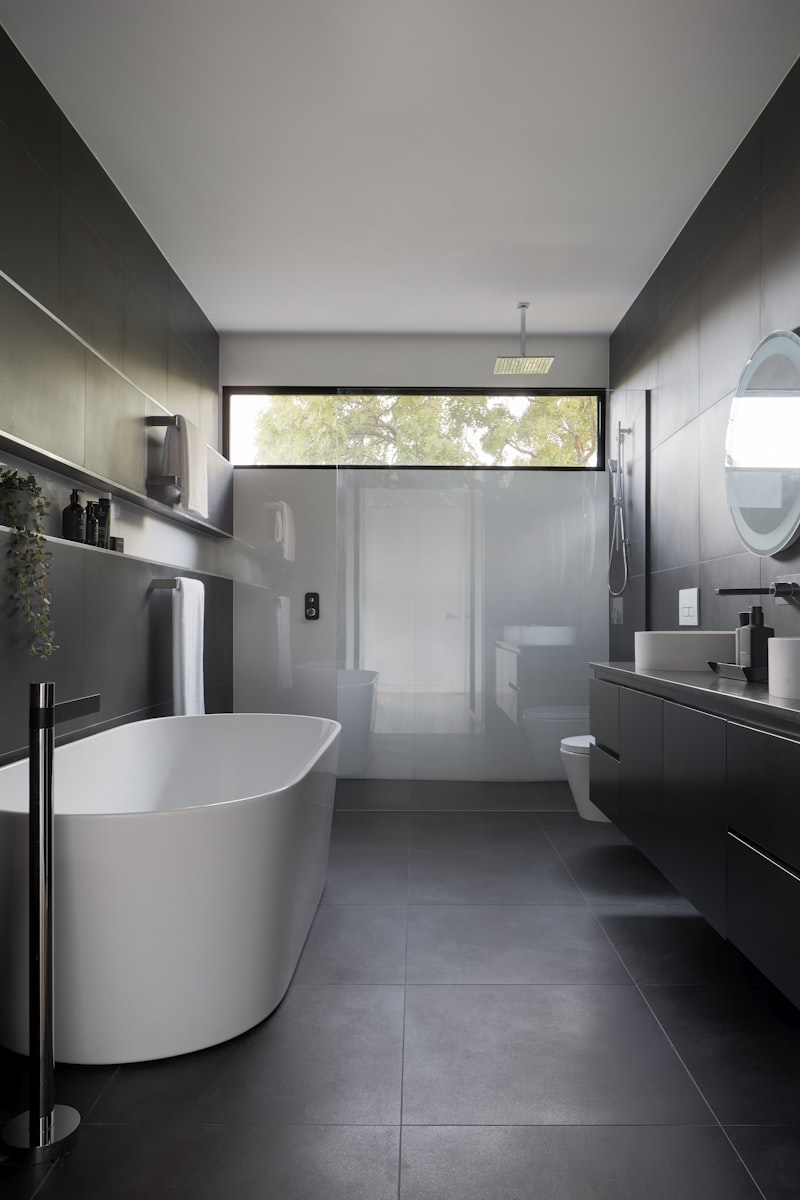
Imagine this: you enter the bathroom and the floor has C3 non-slip porcelain tile throughout. There’s no step between the hallway and the bathroom, or between the bathroom floor and the shower area. The shower is open, floor-level, with a fixed glass panel (no bottom rail to trip on) and a folding seat on the back wall.
There are two grab bars in the shower — one horizontal at hip height and one vertical for gripping when entering — and a folding bar beside the toilet. The taps are thermostatic: you turn, water comes out at 38 degrees, always. No surprises. The toilet is 48 cm high.
The lighting is uniform: an LED panel on the ceiling providing 350 lux and an IP65 downlight over the shower. By the switch there’s a night pilot light that comes on automatically when it gets dark. No cables on the floor. No loose bath mats (loose bath mats are a death trap, by the way — if you have one, throw it out today).
That’s an anti-fall bathroom. It doesn’t look like a hospital. It looks like a modern, clean, well-thought-out bathroom. Because safety and design aren’t at odds. Check our accessible Compact Wet Room design for a real example.
This isn’t just for elderly people
There’s a misconception we encounter constantly: “an adapted bathroom is for old people or for people with disabilities.” No. A safe bathroom is for anyone who uses a bathroom. Which is everyone.
Athletes: A torn ligament, a meniscus injury, an ankle operation. Any athlete knows what it’s like not being able to lift your leg for weeks. And when that happens, the bathtub becomes an impassable barrier.
Pregnant women: In the third trimester, the centre of gravity shifts, balance is altered and feet swell. Getting into a bathtub with an 8-month bump and a slippery floor is a lottery not worth playing.
Children: Children run, jump, don’t look where they’re stepping. Non-slip flooring and a step-free shower significantly reduce childhood bathroom falls.
Anyone with a temporary injury: A bad bout of flu that leaves you dizzy. A sprain. A knee operation. A morning with low blood pressure. You don’t need to be 80 years old to slip in a poorly designed bathroom.
Better safe than sorry. Literally.
How to talk to your parents about bathroom safety
This is the most delicate section. Because we know how it goes: you can see that your mother is 75, that she struggles to get into the bathtub, that she nearly fell one day. And you want to bring it up. But you don’t know how to do it without making her feel like she’s being treated as an invalid.
First: don’t frame it as “Mum, you need a hospital bathroom.” That doesn’t work. Nobody wants to feel their autonomy is being taken away.
Frame it as an improvement. “Mum, I’m looking at renovating my bathroom and I’ve seen these floor-level showers that look great. Have you thought about getting rid of the bathtub?” Or: “Dad, I’ve seen some stainless steel shower bars that look really good. Want me to get you some?”
Second: speak with data, not with fears. “I’ve read that 30% of elderly falls at home happen in the bathroom. And fitting bars costs 100 euros.” Data is neutral. Data doesn’t judge or patronise.
Third: offer to help with the management. What holds many elderly people back isn’t the cost or pride but the bureaucratic hassle. “I don’t want building work, I don’t want hassle.” If you take charge of getting quotes, coordinating the work and processing the dependency aid applications, the “yes” comes much more easily.
And fourth: don’t wait for the accident. The saddest phrase we hear is “I wish we’d done it sooner.” An accessible bathroom renovation takes between 3 and 5 days. Recovery from a hip fracture, if recovery happens at all, takes months.
If your parents live in Valencia or the surrounding area, we can visit the bathroom at no obligation and explain the options calmly. Sometimes, having a professional from outside the family explain it quietly has more effect than a hundred conversations at Sunday dinner. You can see what types of renovations we do in the area on our bathroom renovations in Valencia page.
Frequently asked questions
How much does a complete anti-fall bathroom cost?
It depends on the starting point. If you already have a shower and just need grab bars, non-slip flooring and a thermostatic mixer, you could be looking at €800 to €1,500. If you’re starting from a bathtub and doing a complete conversion to a floor-level shower with all the measures, the range is €3,500 to €7,000. On our website’s calculator you can configure exactly what you need and see an indicative budget instantly.
Are there public grants for adapting the bathroom?
Yes. In the Valencian Community you have the Renhata Plan (up to €3,000), dependency aid (up to €6,000 for Grade III) and the income tax deduction for accessibility works (up to 20% on a maximum of €5,000 of work). We have a complete guide on dependency aid for bathroom adaptation with all requirements and procedures.
Does an anti-fall renovation have to look “like a hospital”?
No. Absolutely not. Current accessible materials are indistinguishable from conventional ones at first glance. Brushed stainless steel bars, stone-coloured resin shower trays, teak wood seats. The Roca Access line is a good example: accessibility with contemporary design. A safe bathroom can be the most beautiful room in the house.
How many days does the work take?
A basic adaptation (grab bars + thermostatic mixer + non-slip strips) can be done in 1 day. A complete bathtub-to-shower conversion with non-slip flooring and bars takes 3 to 5 working days. A full accessible bathroom renovation takes 5 to 8 days. During the work, we arrange a temporary solution so you can continue using water.
From what age should I consider adapting the bathroom?
There’s no magic age. But in terms of real prevention, from age 60 it’s worth starting to incorporate measures. Grab bars and non-slip flooring are cheap investments that don’t bother anyone and can prevent a serious accident. And if there are already mobility, balance or vision issues — regardless of age — the time to act is now, not after the first scare.
Don’t wait for the Sunday call
We end where we started. With the client from Blasco Ibanez. Her mother recovered from the blow. We renovated her bathroom in four days: floor-level shower tray, C3 non-slip flooring, two grab bars, thermostatic mixer and a folding seat. When her mother saw the result, she said: “Why didn’t we do this five years ago?”
Good question.
If you have someone in your life — your mother, your father, your grandmother, your partner, or yourself — who enters an unsafe bathroom every day, don’t leave this article in the “I’ll read it later” tab. Do something. Even if it’s just fitting a €40 grab bar this weekend.
And if you want to do things properly, we’re here. We can visit the bathroom, measure up, propose solutions and give you a fixed quote with no surprises. No obligation. No pressure. Just professionals who’ve been doing exactly this for 12 years.
Because better safe than sorry. And in the bathroom, that phrase isn’t a saying: it’s the difference between a normal life and a broken hip.