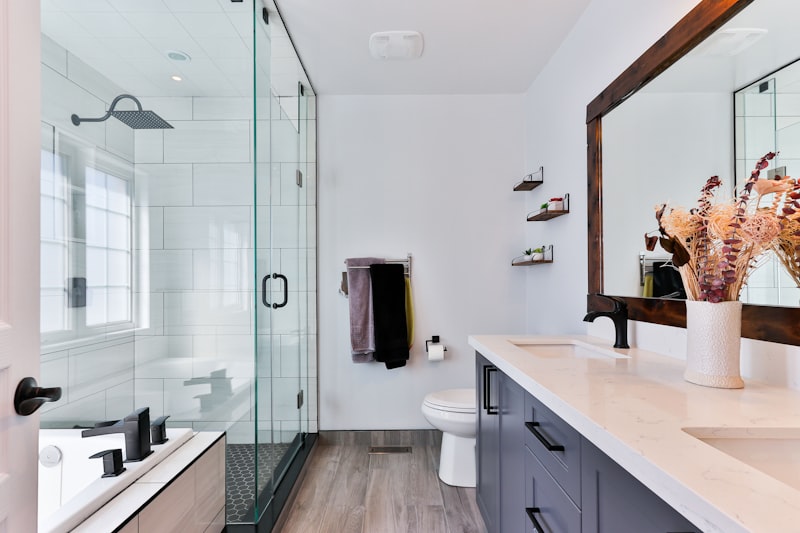
You step into the shower, look up, and water falls from above — like standing in warm rain. No hose dangling from a bar, no chrome rail in sight. Just a flush-mounted ceiling rain shower head and water dropping straight onto your shoulders. It is one of the most-requested features when people do a serious bathroom renovation here in Valencia, and also one of the things most often done wrong.
A ceiling rain shower head fitted properly is an absolute pleasure. Fitted badly, it is a dispiriting dribble that leaves you half-wet. The difference is rarely the price of the showerhead itself — it is the installation, the height and the flow rate. Here is what you need to know so you can ask the right questions and avoid the common mistakes.
What exactly is a ceiling rain shower head?
It is a large showerhead — typically square or round — set into the false ceiling of the bathroom. The arm and pipework are hidden above the plasterboard or ceiling panel, so from below you only see the trim ring. Water falls vertically, spread across many outlets, mimicking rainfall.
There are two ways to fit one:
- Fully recessed into the ceiling. The head sits flush, completely integrated. It requires a false ceiling and building work. This is the cleanest finish and what nearly everyone wants.
- Ceiling-arm mounted. A tube drops from the ceiling and holds the showerhead. Easier to install, no hidden service access needed, but the arm remains visible.
The recessed version looks better — no argument there. But it has one drawback almost nobody mentions upfront: maintenance. If the concealed valve develops a fault, you have to open the ceiling. That is why we always insist on leaving a proper access hatch.
The ideal height: the detail almost everyone gets wrong
This is the crux of it. A wall-mounted showerhead can be angled, raised or lowered. A ceiling one cannot. You fix the height during the build and it stays there forever. Get it wrong and you live with it.
The rule we follow: leave at least 30 cm of clear space above the head of the tallest person in the household. And measure generously — allow for hair, and for raised arms.
| User height | Recommended showerhead height (from floor) |
|---|---|
| Up to 1.65 m (5’5”) | 200–210 cm |
| 1.66–1.80 m (5’5”–5’11”) | 210–220 cm |
| Over 1.80 m (5’11”) | 220–230 cm |
These figures work for standard ceiling heights. The classic problem in many flats in Valencia’s Eixample district is the opposite: ceilings of three metres or more. You cannot recess the head at its true height because it would sit at three metres and the water would arrive cold and scattered. The solution is to drop a false ceiling over the shower zone only, or use a ceiling arm at the correct height.
Our honest view after many renovations: if household heights vary a great deal (say, a 1.90 m adult and young children), a fixed rain showerhead is not the ideal sole option for everyone. We almost always add a separate hand shower on a second outlet. That way everyone manages fine.
Flow rate and pressure: without these, it does not rain
A 30 × 30 cm rain showerhead has dozens of water outlets. For all of them to produce a decent stream, you need volume. This is where a lot of people get a nasty surprise.
The minimum pressure recommended by most manufacturers for a rain showerhead is around 2 bar (200 kPa). Below that, the water trickles out and you end up shivering. Roca, for example, specifies an optimal working pressure of between 1 and 5 bar for their shower columns and heads in their technical documentation. If your property’s pressure is on the low side, measure it before buying anything.
Two things to check:
- Pipe diameter. For a large showerhead, the ideal is a ½” feed pipe at minimum — larger if the installation allows. Restricting the supply through a narrow pipe kills the rainfall effect.
- Water consumption. Rain showerheads use a lot of water. For that reason, Spanish regulations introduced consumption limits for new devices in 2013: the Código Técnico de la Edificación (Spain’s Building Technical Code — the equivalent of the UK Building Regulations) sets flow limits for sanitary fittings. Many quality showerheads come with a built-in flow limiter set to around 9 litres per minute. Check the label before you buy, because the difference in running costs between models is significant.
If your pressure is genuinely low, the solution is not a more expensive showerhead — it is often a pressure booster pump, which we factor into the renovation spec. If you want to understand why your shower runs weak and what can be done about it, we cover it in detail in our guide on low water pressure in the shower.
The valve: thermostatic is almost essential
With a fixed rain showerhead, adjusting temperature using a standard single-lever mixer is a nuisance. The water takes a while to travel down, there is a lot of it, and you end up scalded or frozen while you fiddle. That is why we nearly always recommend concealed thermostatic valves: you set your temperature once and it holds.
If you are weighing up the different types of concealed valve and how they are serviced, our guide on concealed shower valves goes into the detail. And if you prefer a surface-mounted column rather than burying everything in the ceiling, take a look at the comparison in our article on the thermostatic shower column with waterfall and rain functions — that is the alternative that avoids the heavier building work.
The access hatch: the detail that saves you a fortune
We keep repeating this because it matters. Every concealed fitting — whether in the wall or the ceiling — must remain accessible for repair. In a ceiling installation that means leaving a service hatch or a demountable section of plasterboard directly above the valve.
We see it all the time: someone recesses the thermostatic cartridge, closes up the ceiling, tiles everything beautifully, and three years later the cartridge seizes up with limescale. To swap a €40 part, they have to cut open the ceiling and make it good again. An expensive, avoidable mess — all to save the cost of a hatch. In Valencia, with the hard water we have, this happens more often than you would think.
How much does a ceiling rain shower installation cost?
It depends heavily on the showerhead and on whether a false ceiling is needed. For a rough sense of the numbers within a full bathroom renovation:
| Item | Approximate range |
|---|---|
| Ceiling rain showerhead (mid-range) | €120–€350 |
| Concealed thermostatic valve | €150–€500 |
| False ceiling + access hatch (shower zone) | €150–€400 |
| Labour — concealed plumbing | €200–€450 |
These are indicative figures, not a quote. The finish, the brand and the condition of your existing installation all shift things considerably. For an estimate on your full bathroom renovation, use our cost calculator — it gives you a sensible figure in about two minutes.
Frequently asked questions
Do I need a false ceiling for a recessed rain showerhead?
For a fully flush-fitted head, yes — the pipework has to go somewhere, and that somewhere is above the plasterboard. If you do not want to touch the ceiling, the ceiling-arm option is the answer: it mounts on the surface and leaves the pipe visible.
Will my water pressure cope with a rain showerhead?
You need around 2 bar minimum for a proper rainfall effect. If your property’s pressure is uncertain, measure it before committing to a purchase. If it comes up short, a pressure booster pump can be included in the renovation.
Can I combine a ceiling rain shower with a hand shower?
Yes, and we recommend it. A diverter valve lets you switch between the fixed head and a hand shower. It is the most practical setup for cleaning the enclosure, rinsing off quickly, or catering for people of different heights. If you want both running at the same time or a full spa feel, have a look at our article on a double shower with two showerheads.
Will it work in a small bathroom?
Absolutely. The showerhead is in the ceiling, so it takes no wall space and steals no floor area. In fact, because there is no bar or column to see, the enclosure reads as cleaner and the room feels larger.
Does concealed plumbing need a lot of maintenance?
Not if you leave an access hatch. Problems only arise when the ceiling is sealed with no way in. With a hatch in place, swapping a cartridge takes minutes. Without one, it means opening up the ceiling.
Get it right once and forget about it
A ceiling rain shower is not a complicated indulgence — it is a building decision that requires some thought. Nail the height for whoever is using it, confirm the flow rate before you choose the head, fit a thermostatic valve and, please, leave an access hatch. Do those four things and you have a hotel shower at home for the next twenty years.
Thinking about a bathroom renovation in Valencia and want a rain shower done properly? See how we approach bathroom renovations in Valencia and tell us about your project — we will tell you exactly what will work with your ceiling and your pressure, no sales pitch.
Calculate your bathtub-to-shower swap price
Turnkey price regardless of size