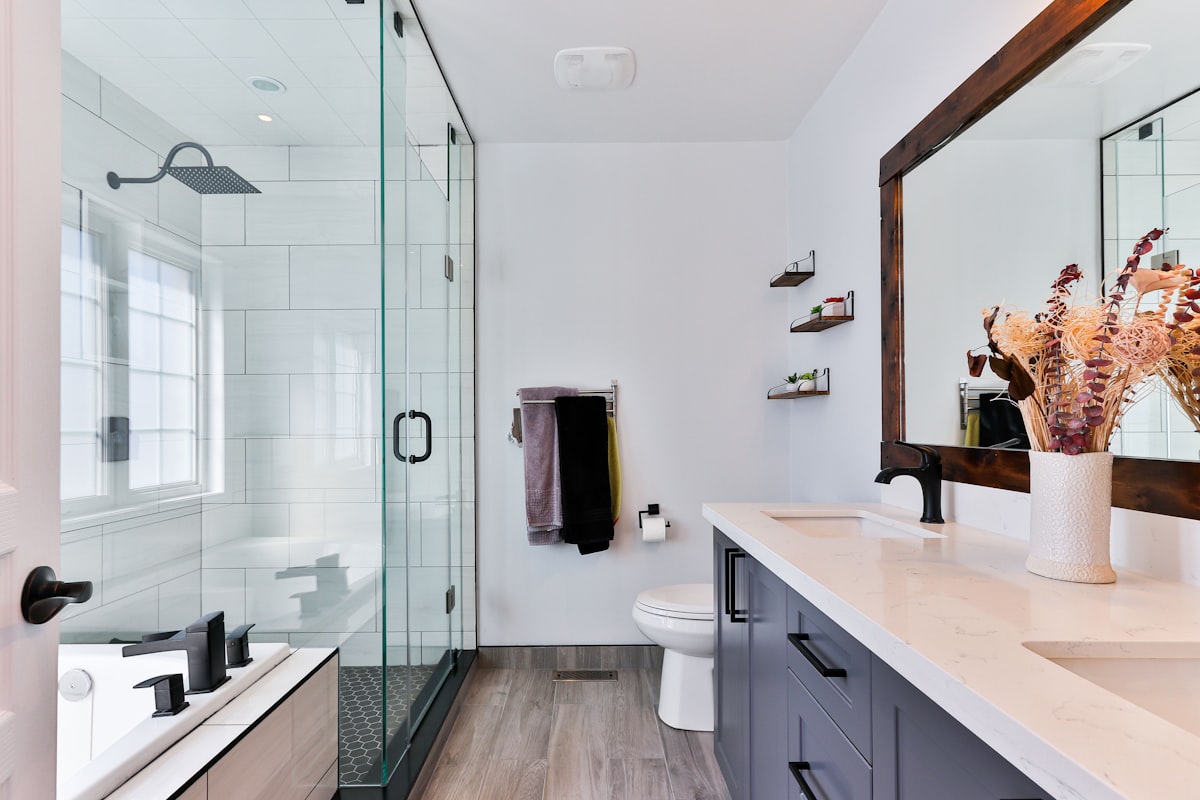
Say “glass mosaic tiles” and some people picture the pool at a holiday resort or the bathroom their grandparents had in the 1970s. There’s a grain of truth in that — mosaic tiles have been around for decades. But the material has moved on, the formats have multiplied, and that blue-tile look that once felt dated is back in force in the bathroom renovations we’re doing along the Valencia coast. This isn’t nostalgia: a well-laid glass mosaic does something a plain large-format tile simply cannot.
Glass mosaic tiles — gresite, as they’re known in Spain — are small tesserae of glass (sometimes porcelain or natural stone) mounted on a mesh backing. That mesh is what lets you clad curves, columns and awkward corners where a full-size tile would never fit. It’s exactly why glass mosaic tiles for showers work so well: there’s always an odd recess or radius that needs solving.
Why glass mosaic tiles for showers still deliver
Glass doesn’t absorb water. Full stop. Its porosity is essentially zero, so the material itself won’t stain from within or harbour moisture. In a space that gets wet ten times a day, that’s precisely what you want.
Then there’s the light. The tesserae reflect, which makes a small shower feel bigger and more alive. A panel of blue mosaic tiles behind the shower head turns a grey cubicle into something you actually want to look at. We recommend them above all for creating a focal point: one wall, a recessed niche, or the front face of a built-in bench. Cladding the entire shower in mosaic is a different matter — we’ll explain why shortly.
The other great strength is adaptability. A round column in the middle of the bathroom — a legacy of an older building in El Cabanyal or the Casco Antiguo? Glass mosaic tiles wrap it without ugly cuts. A custom shower tray with a linear drain and subtle slopes? The tesserae follow the contour without the join showing.
Types of glass mosaic tile
Not all glass mosaic tiles are the same. The difference in price and finish between one type and another is substantial, so it pays to know what you’re looking at. Ceramic and glass wall cladding is, incidentally, one of the great trades of the region — the sector’s trade body, ASCER, is based in Castellón, just up the road.
| Type of mosaic tile | Finish | Approx. material price (€/m²) | Where it works best |
|---|---|---|---|
| Standard recycled glass | Matt or plain gloss | 18 – 35 | Showers, wet walls |
| Pearl / iridescent glass | Shifting lustre | 35 – 60 | Feature panels, niches |
| Venetian glass (smalti) | Solid glass, intense colour | 60 – 150 | Luxury details, water walls |
| Glass + natural stone mix | Combined textures | 40 – 80 | Spa style, warm bathrooms |
| Classic pool-style mosaic | Blue gloss | 12 – 25 | Showers, wellness zones |
These figures cover materials only, not fitting. And that’s where the real cost sits.
The honest truth about labour
Glass mosaic tiles are not expensive because of the material; they’re expensive because of the hours it takes to fit them. This is where a lot of people get a shock when they see the final quote.
A large-format tile goes up quickly. Mosaic sheets need to be aligned sheet by sheet so the tesserae don’t jump at the joins. On corners and curves you sometimes have to cut tile by tile. It’s painstaking work.
In practice, fitting glass mosaic tiles costs two to three times more in labour than a standard tile installation. In Valencia, mosaic fitting runs to roughly 40–70 €/m² for labour alone, compared to 20–30 €/m² for standard porcelain. That’s why almost nobody clads an entire shower in mosaic: it becomes very expensive very quickly, and frankly the result doesn’t improve enough to justify it. A well-chosen feature panel looks just as striking and costs a fraction of the price.
One point that really matters: the grout. Glass mosaic tiles have far more grout lines than large tiles — obvious, given the size of the pieces. That means more mortar exposed to water. Always use epoxy grout in the shower, never cement-based. It costs more to apply, but it’s fully waterproof, won’t stain and won’t grow mould. With cheap cement grout, you’ll have black lines in two years. We’ve seen it too many times.
Beneath all of that, what actually protects the floor below is the waterproofing of the wet zone: a membrane or waterproofing coat applied under the tiles. Spain’s Building Technical Code (Código Técnico de la Edificación — the equivalent of Building Regulations in the UK) requires this wherever there’s a risk of water infiltration, and with so many grout lines, glass mosaic tiles are no exception. The tesserae insulate, but the grout is not infallible.
Maintenance: neither too much nor too little
The glass itself is no trouble: a cloth and water, done. What gives any shower in the Valencian Community a hard time is limescale. The water here is genuinely hard, and it shows more on mosaic tiles because there are more grout lines for deposits to grip onto.
With epoxy grout, limescale comes off with diluted white vinegar or a dedicated descaler — no need to scrub aggressively. If cement grout was used (a bad idea, but it happens), you’ll need to re-seal it periodically. We cover this properly in our guide on tackling limescale on taps and shower screens, because the enemy is the same right across the shower.
One figure worth knowing: water hardness in a large part of Valencia province routinely exceeds 30 French degrees, according to data published through Spain’s National Drinking Water Information System (SINAC). In plain English: if you don’t choose the right grout, you’ll pay for it in cleaning time.
Glass mosaic or porcelain? Our honest view
We get asked this on almost every site visit. The honest answer is that they don’t compete — they do different things.
Large-format porcelain tile is practical, has few grout lines, cleans in moments and costs less to fit. For cladding the whole shower, it wins hands down. Glass mosaic tiles are for the detail, the character, the piece you want to stand out. Our standard recommendation is to combine them: porcelain on the main walls and a mosaic feature panel where you want the focal point. The price balances out, and the result has personality without the “municipal swimming pool” effect of cladding everything in blue gloss.
If you like tiles with a handmade soul, have a look at our guide to hydraulic tiles in the bathroom — another Mediterranean classic that pairs beautifully with glass mosaic. And if you’re after that light, coastal feel throughout the whole space, our guide to the Valencian Mediterranean bathroom maps out the full palette of materials and colours.
Where a mosaic panel works best
- Behind the shower head. The most-viewed spot in the shower. A vertical panel there changes the whole bathroom.
- In the recessed niche. That built-in shelf for shampoo and soap is made for mosaic: it’s small, has corners, and the material fits without awkward cuts.
- On the front face of a built-in bench, to finish the zone with a different texture from the main walls.
We’re nearly always talking about contained surfaces. Glass mosaic tiles shine — literally — when they’re the star of a corner, not when they cover everything.
Frequently asked questions
Are glass mosaic tiles slippery on the shower floor?
Glossy glass mosaic on a shower floor is indeed slippery. For the shower tray you need an anti-slip mosaic or tile with the correct classification (Class 3 or R11 minimum). On walls the finish doesn’t matter for safety, but on the floor don’t take the risk.
How much does it cost to fit glass mosaic tiles in a shower?
It varies considerably depending on the surface area and type of tessera. A two-square-metre feature panel with mid-range material and epoxy grout typically comes to €300–500 for materials and labour combined. Cladding the whole shower multiplies that figure. For a figure tailored to your bathroom, use our renovation calculator.
Can you lay glass mosaic tiles over existing tiles without hacking off?
Sometimes, yes — if the existing surface is solid, well-bonded and the right adhesive is used. But glass mosaic tiles need a very flat substrate, so removing the old tiles often makes more sense. It’s something the tradespeople carrying out the work will need to assess on site.
Do glass mosaic tiles go out of fashion?
The classic bright-blue pool look has had its ups and downs. But glass mosaic tiles in pearl finishes, warm earthy tones or combined with natural stone are timeless. Choose the right finish and you won’t be regretting it in five years.
What grout should you use with glass mosaic tiles in the shower?
Epoxy grout, without question, in any wet area. It’s waterproof, won’t stain and won’t grow mould. It costs more to apply, but it saves you from re-grouting and black lines appearing within two years.
A small detail that changes everything
Glass mosaic tiles aren’t for every wall. They’re for people who want their shower to have a wink of personality — a touch of colour, that Mediterranean shimmer that reminds you where you live. Chosen well and finished properly (epoxy grout, a fitter who knows what they’re doing), they’ll last for years and be a pleasure to look at every morning.
If you’re renovating and you’re not sure where to work in a mosaic detail, or how to tie it in with the rest of the bathroom, come and talk it through with us. Have a look at how we approach bathroom renovations in Valencia and tell us about your project: we’ll tell you which panel makes sense and what it will actually cost — no surprises in the quote.
Calculate your bathtub-to-shower swap price
Turnkey price regardless of size