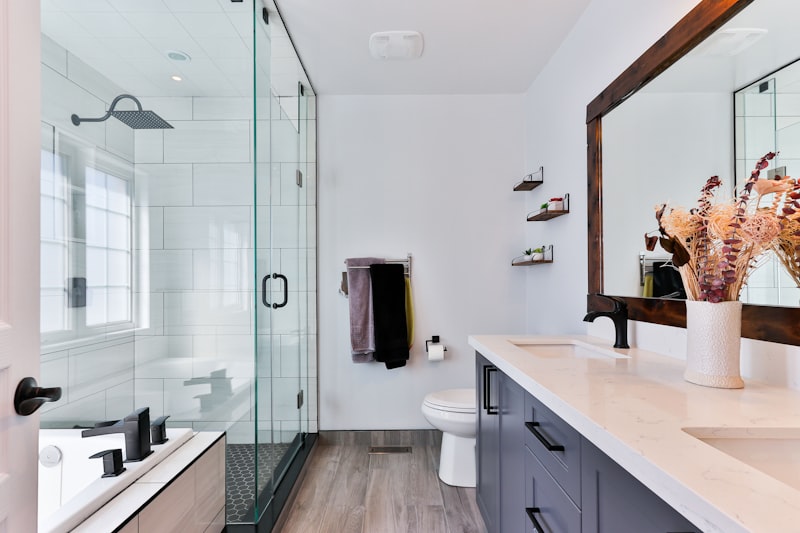
Your Oliva beach apartment is perfect for nine months of the year. The problem starts when you arrive in June, open the bathroom door, and you’re hit by that musty smell, white deposits all over the taps, and grout that’s gone black since Easter. If that sounds familiar, you’re not alone.
A bathroom renovation in Oliva is a different beast from a city flat that gets daily use. Here, two enemies rule: the salt air off the sea and the damp that builds up in a bathroom left unventilated for months on end. Ignore either one and you’ll end up renovating twice. Here’s what changes, and why.
Why bathroom renovation in Oliva plays by its own rules
Oliva sits right on the coast. La Devesa, the seafront promenade, the first-line urbanisations — all of them take the brunt of salt-laden sea air almost year-round. And salt air is ruthless. It goes after any exposed metal, rusts screws, pits chrome fittings, and leaves that stubborn white film on taps and shower screens that won’t shift no matter how hard you scrub.
Add to that the second issue: most bathrooms in Oliva belong to holiday homes. Locked up from September to June, no ventilation, no use. The water in the traps evaporates, moisture gets trapped inside, and mould has the run of the place. When you come back, the bathroom looks like it’s aged a year in six months.
Our honest take, after many renovations along this coastline: in Oliva, scrimping on materials is a false economy. It’s the one place where cheap genuinely costs more in the long run.
Salt-resistant materials: where to invest and where you can ease off
Not every part of the bathroom suffers equally. Salt air targets metals and anything near a window or terrace. That’s where it pays to go up a grade:
Taps and mixers: stainless steel or solid brass — no budget alloys
AISI 316 stainless steel or brand-name chrome-plated brass mixers stand up to a marine environment. Zinc alloy (zamak) — the stuff most budget taps are made from — pits within a couple of summers. Brands such as Roca make ranges specifically designed for coastal conditions, and the price difference over a generic set is nothing compared to an early replacement job.
Shower screens: anodised aluminium frames and treated glass
Anodised or powder-coated aluminium holds up against salt air far better than raw aluminium profiles. Toughened glass with a limescale-resistant coating cuts cleaning time in half. Cheap screens with untreated frames are the first thing to go on a coastal property.
Fixings and hardware: stainless steel, always
It’s the detail that ruins otherwise good bathrooms. Hinges, fixing screws, towel rail brackets — if they’re not stainless steel, they’ll rust and leave brown streaks down your tiles. It costs a few euros more per fitting. Ask for it.
Wall and floor coverings: porcelain, sealed microcement or stone effect tiles
Porcelain is virtually impermeable and salt air simply doesn’t bother it. Large-format porcelain tiles also mean fewer grout lines, which are the weak point where mould takes hold. If you like the look of microcement, make sure it’s properly sealed — we cover this in our complete guide to microcement in bathrooms, because microcement applied without proper sealing in a wet room will give you grief.
The “months-closed” problem — and how we design around it
A holiday home has one requirement that a permanently occupied flat doesn’t: the bathroom needs to look after itself, with no one there to maintain it. That’s something you plan into the renovation, not a fix you bolt on afterwards.
What we recommend building in:
- Anti-syphon membrane traps (such as HepvO valves), which seal without relying on water. No water in the trap means no sewer smell rising up, even if the bathroom has been shut for months. It’s the single biggest cause of that “stale” smell when you open the door — we go deeper on this in our article on bad bathroom smells and their causes.
- Ventilation designed for absence: an extractor fan with a timer or humidistat that kicks in automatically when humidity rises. Far better than a hermetically sealed bathroom growing mould in the dark.
- Materials that need no upkeep: the less there is to scrub and check between visits, the better. Porcelain tiles and wall-hung sanitaryware (which leave the floor clear for a single-pass clean) win hands down.
If this is your exact situation, we’ve written a dedicated guide on the differences when renovating a holiday home bathroom that goes into more detail.
How much does a bathroom renovation in Oliva cost?
Prices in the Gandia and Oliva area track closely with the rest of the Valencian Community, with a modest premium for logistics on urbanisations that are slightly off the main routes. These are real ranges for a full renovation, mid-to-good quality materials included:
| Bathroom type | Floor area | Indicative range |
|---|---|---|
| Small cloakroom / WC | Under 4 m² | €4,500 – €6,500 |
| Standard bathroom | 4 – 6 m² | €6,500 – €9,500 |
| Large bathroom / freestanding bath | Over 6 m² | €9,500 – €14,000 |
These are indicative figures: the actual quote depends on the spec, whether the pipework needs touching, and how accessible the property is. For a figure tailored to your bathroom, use our renovation cost calculator or have a look at our general breakdown for bathroom renovations in Valencia.
For context: according to INE (Spain’s National Statistics Institute), the province of Valencia has one of the highest proportions of second homes on the entire Mediterranean coast, and a significant share are let out during summer. If that’s your plan, a properly renovated bathroom raises what you can charge per night and cuts complaints from guests.
If you’re letting the flat out in summer
More and more Oliva owners are making their apartments work while they’re not using them. If that’s you, the bathroom is the first thing guests notice. A shower screen that won’t close properly or a pitted tap will tank your review score more than you’d expect. Renovating with letting in mind has its own return-on-investment logic — we break it down in bathroom renovation for holiday lets and its ROI.
In our experience, the winning formula for a coastal rental is straightforward: a walk-in shower instead of a bath (safer and quicker to clean between guests), non-slip flooring, good lighting, and a couple of details that photograph well for the listing. Nothing extravagant — this is an investment, not an indulgence.
How we work along the Oliva and Gandia coast
We cover the whole stretch, from Oliva down to Gandia port and the beach urbanisations in between. We come to you, take measurements, explain which materials will genuinely stand up to the marine environment, and give you a fixed quote. If your flat is far away and you can’t be there in person, we coordinate site visits and send you photo updates as the work progresses — it’s what we do every day for owners based elsewhere.
Get in touch for a no-obligation quote.
Frequently asked questions
Does salt air really affect an interior bathroom — one with no sea-facing window?
Yes, though less severely than a bathroom with a terrace window. Sea breeze gets in through gaps and ventilation, and the general atmosphere inside a coastal property is more corrosive than somewhere inland. That’s why we recommend stainless steel hardware and decent-quality taps even in bathrooms with no direct exterior opening.
My flat is shut all winter. What materials hold up best on their own?
Porcelain on floors and walls, wall-hung sanitaryware, anti-syphon membrane traps, and taps that won’t pit. The goal is a bathroom that needs zero upkeep between seasons. The less there is to worry about, the better the state you’ll find it in when you return.
Can you do the renovation out of season so it’s ready for summer?
That’s the ideal scenario. Renovating in autumn or winter, when you’re not using the flat, means you don’t lose a single week of beach time or rental income. A standard bathroom renovation takes us one to two weeks on site.
How much does it cost to replace just the taps and shower screen because of salt damage?
If the bathroom is otherwise sound and you only want to swap out the parts that have suffered, that’s a targeted job — far cheaper than a full renovation. Use our cost calculator or tell us the situation and we’ll let you know honestly whether it’s worth just replacing those pieces or going further while we’re there.
Do you work in the first-line beach urbanisations in Oliva?
Yes, across the entire coastal strip of Oliva and Gandia, urbanisations included. Where needed, we coordinate access and working hours with the residents’ association.
Renovate once, enjoy many summers
On the coast, a poorly thought-out bathroom forces you to renovate twice: first for aesthetics, then again because the salt air and damp have eaten through what you saved the first time. Don’t fall into that trap. The right materials for a marine environment, practical solutions for the months when nobody’s there, and a design that means the flat greets you just as you left it.
Tell us about your Oliva bathroom and when it’s free. Ask us for a quote and we’ll come and see it — we’ll tell you honestly what needs doing and what doesn’t, without overselling.