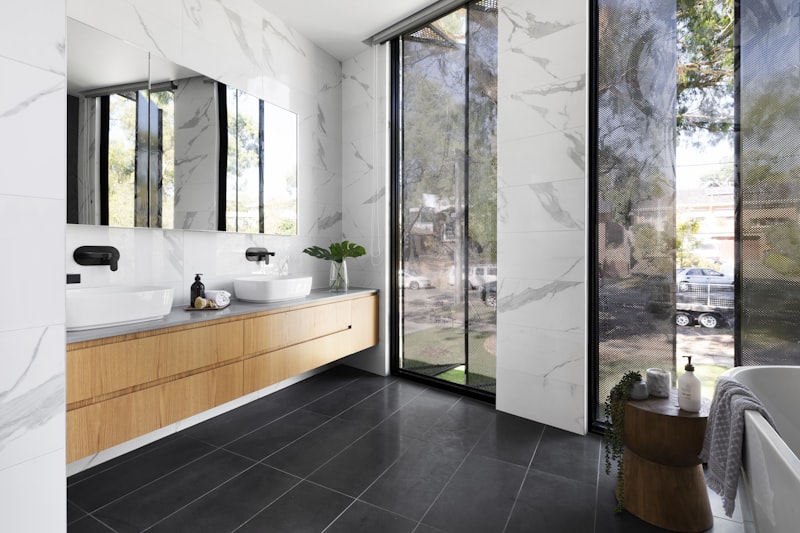
In Valencia, countless flats have no utility room, no terrace, no galería — nowhere sensible to put a washing machine except the bathroom. And it almost always ends up in the worst possible spot: squeezed next to the toilet, detergent bottles piled on top, in full view. A bathroom laundry room combo doesn’t have to look like that. Done properly, the washing machine disappears behind a door and the bathroom still feels like a bathroom.
The problem isn’t having the washer in there. The problem is that nobody thought about it when the bathroom was designed. It got plugged in wherever it fitted, and that was that. Here’s how to actually fix it.
Why a bathroom laundry room combo makes sense (and when it doesn’t)
Putting the laundry zone in the bathroom means all your water connections are in one place — same waste pipe, same drain, same plumbing run. That saves a significant amount of work compared to creating a separate utility area in another room.
It makes sense if your flat has no utility room, if the kitchen is already tight on space, or if you want to free up square metres elsewhere. It makes less sense if you have a closed-in terrace nearby or a roomy kitchen — in those cases the washing machine is usually better off outside the bathroom, away from where steam and humidity already build up.
Because that’s the detail most people overlook: the bathroom is already the dampest room in the house. Adding a washing machine that pumps out steam on every spin cycle means you need serious ventilation — not a three-euro extractor fan.
Four ways to hide the washing machine
There’s no single right answer. It depends on how much floor space you have and where the water supply is. These are the four solutions we use most often.
1. Under-counter washing machine
The cleanest option. The machine slots under a continuous worktop — just like in a kitchen — with the basin or a work surface above it. A door or panel in the same finish as the rest of the furniture makes it vanish. From the outside it looks like a standard bathroom base unit.
You need around 60 cm of clear width and enough height. Standard washing machines are between 82 and 85 cm tall (check the technical specs from manufacturers like Roca or any appliance brand), so the worktop sits a little higher than usual. It works perfectly well.
2. Stacked washer-dryer column
Short on width but with a free wall that runs all the way up? Go vertical. Dryer on top of the washing machine, both tucked inside a tall column unit with doors. It takes up just 60 cm of floor space and makes use of the height that bathroom walls almost always waste.
This is our favourite solution for long, narrow bathrooms — those corridor-style rooms with a bath at the far end that are so common in the Eixample and Ruzafa areas. You borrow half a metre of wall and gain both a washer and a dryer without sacrificing any walkway.
3. Behind sliding or wardrobe doors
A floor-to-ceiling fitted unit with the washing machine inside alongside shelves for detergent, towels, and everything that usually clutters the room. Sliding doors if the bathroom is narrow, hinged if there’s room to swing them. Closed, it reads as just another wall.
4. Under-stair alcove or awkward niche
If the bathroom is near a staircase, or has one of those odd recesses that seems to serve no purpose, that’s often exactly where a washing machine fits. We’ve resolved this many times in bathrooms and cloakrooms built under stairs, where dead space becomes a proper utility zone.
How much space you actually need
The machine isn’t just its width. You have to account for the depth with pipes behind it and the clearance needed to open the door (front-loaders need roughly 50 cm in front). This is the reference guide we use when quoting:
| Solution | Minimum width | Notes |
|---|---|---|
| Under-counter washer | 60 cm | Worktop at 85–90 cm height |
| Stacked washer + dryer column | 60 cm | Uses the full height — ideal for narrow rooms |
| Behind fitted wardrobe | 65 cm | 5 cm extra for door panels and runners |
| Under-stair alcove | Variable | Check the height — that’s usually the constraint |
If your bathroom is under 4 m², a column unit or an adapted alcove are almost always the only realistic options. We cover this in detail in the guide to renovating a small bathroom under 4 m².
Three technical details people consistently forget
The water supply and waste outlet. If the machine is moving to a new position, you need to run both the water feed and — critically — the waste pipe to that point with the correct fall. This is what drives up the cost when the chosen location is far from the main soil stack.
Anti-vibration measures. A washing machine wedged tightly inside a cabinet will vibrate and rattle twice as much as one in the open, if it isn’t properly isolated. Levelling feet adjusted correctly, a bit of clearance all round, and a solid base. If the spin cycle makes the mirror shake, it’s been fitted badly.
Ventilation. A washing machine and a shower in the same room is a lot of moisture in one space. A bathroom like this needs an extractor with proper airflow capacity, not the bare minimum. We go into this properly in the bathroom ventilation guide. Skip this and within six months you’ll have mould in the grout and silicone.
Making sure it doesn’t look like a laundry cupboard
This is the difference between a botch job and a proper renovation. The trick is that whatever panels conceal the washing machine match everything else in the bathroom exactly — same colour, same handle style (or handle-free), same lines. If the machine door stands out, the whole thing stands out.
A couple of things that work well: a floating shelf above the unit so the eye reads “bathroom” before “laundry room”, and a basket or a few folded towels on show to break the utilitarian feel. Our honest take, after doing quite a few of these: if you’re torn between half-hiding the machine and closing it off completely behind a full panel, go for the full panel. The halfway house is what always ends up looking off.
According to the INE (Spain’s National Statistics Institute), 99.4% of Spanish households own a washing machine (Household Equipment Survey, INE). That’s virtually everyone. And most of them have it on display — not by choice, but because nobody planned for it. You still have the chance to plan it properly.
How much does it cost to integrate a washing machine in a bathroom?
It depends almost entirely on whether the machine stays near its existing connections or whether pipework needs to be moved. If it’s staying put and it’s simply a case of enclosing it with a bespoke unit, it’s a moderate cost within an overall renovation. If the plumbing has to go to a different point in the room, the price goes up. The quickest way to get a realistic figure is our renovation cost calculator, which gives you a range in a couple of minutes.
If you want to see finishes and combinations before making any decisions, have a look at our bathroom design gallery. And if you’re ready to move forward, see how we handle bathroom renovations in Valencia.
Frequently asked questions
Is it legal to put a washing machine in the bathroom?
Yes, as long as the electrical and water installation meets current regulations. The socket must be at a safe distance from the shower or bath, in line with the protection zones set out in the CTE (Spain’s Building Technical Code — Código Técnico de la Edificación, codigotecnico.org). This is a job for a qualified electrician — not something to improvise.
Will the moisture from the washing machine damage the bathroom?
If the ventilation is inadequate, yes — you’ll get mould on grout lines and silicone seals. With a decent extractor fan or an opening window, there’s no problem. The key is refreshing the air after every wash cycle and every shower.
Can I fit a washer and dryer in a small bathroom?
Yes, by stacking them. One on top of the other takes up just 60 cm of floor space and uses the wall height instead. It’s the go-to solution for narrow bathrooms where you couldn’t fit them side by side.
Will the washing machine be noisy inside a cabinet?
Only if it’s not levelled properly or has no clearance. Fitted correctly — feet adjusted, a bit of space around it — it actually runs quieter than in the open, because the cabinet absorbs some of the vibration. The classic mistake is jamming it in too tight.
Do I need to renovate the whole bathroom to integrate the washing machine?
Not necessarily. If the water connections are already close by, a bespoke cabinet to enclose it may be all you need. A full renovation only becomes necessary when the plumbing has to move. Tell us what your bathroom looks like and we’ll tell you which category you fall into.
The washing machine doesn’t have to ruin your bathroom
Having the washing machine in the bathroom isn’t the problem. Having it on full display, badly positioned and without any plan — that’s the problem. With the right layout and a panel that matches the rest of the room, it disappears completely. Nobody would ever know it was there.
Got a washing machine sitting in the middle of your bathroom and want to deal with it properly? Tell us what you’re working with and we’ll suggest the solution that fits your space and your budget.