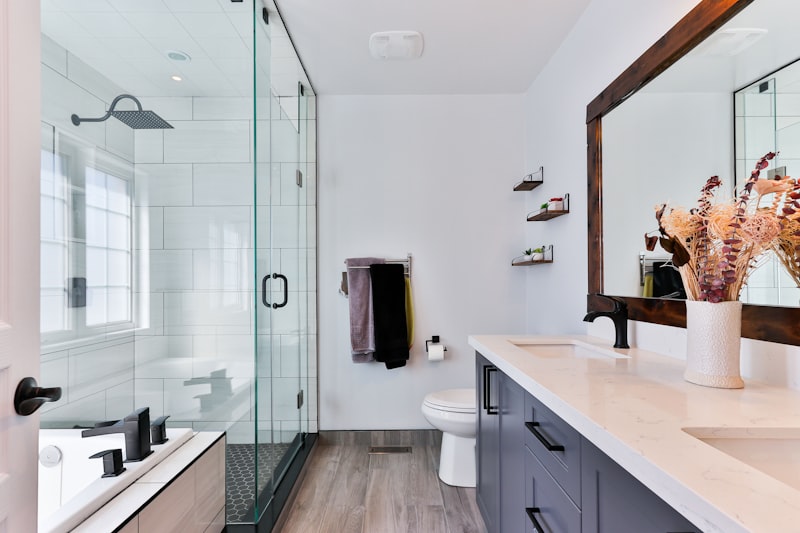
You walk into a bathroom and the floor runs wall to wall without a single grout line breaking up the space. Clean, open, straight off a design magazine. That is exactly what people mean when they ask us for a continuous floor bathroom: one uninterrupted surface that reads as a single piece.
The thing is, “continuous” describes a look, not a material. And you can get there by two very different routes: microcement or large-format porcelain. They look almost identical in photos, and they differ in nearly everything else. Here is an honest breakdown.
What a continuous floor bathroom actually means
Continuous means the eye finds no interruptions. With microcement that is literally true — it is applied as a coating that covers the entire floor with zero joints. With large-format porcelain it is almost true: you use slabs so large (120×120 cm, 120×260 cm) that the joints shrink to one or two millimetres — at normal standing distance they simply disappear.
Both can go over an existing floor without breaking it up, both create that sense of space, and both look excellent in a modern bathroom. The difference shows up in how they handle water, knocks, and your budget over the next five years.
Microcement: no joints at all, but it demands skilled hands
Microcement is a cement-based coating applied in thin layers over the existing floor. The result is a genuinely seamless surface — not a single grout line anywhere in the room. That is why it turns heads.
What the Instagram photos do not show is that a good microcement job depends almost entirely on the person applying it. Done badly, you get cracks in the corners, staining where the sealant fails, and a rough texture where you do not want one. Done well, it holds up for years. That is both the appeal and the risk. If you are thinking about microcement on the walls or in the shower enclosure as well as the floor, we go into it in depth in our complete guide to microcement in bathrooms.
One thing we tell every client without exception: the microcement on the shower floor must have a dedicated sealant and a slip-resistant finish. Without those, a wet microcement floor is dangerously slippery. A bathroom is no place to cut corners on grip.
Large-format porcelain: near-seamless by sheer size
The other route is large-format rectified porcelain. It is not completely continuous, but with tiles of 120 cm or more and a tiler who knows the trade, the joints are so fine the effect is virtually the same. And you gain something microcement cannot give you: factory-grade hardness.
Porcelain stoneware is fired above 1,200 °C, absorbs no water and does not scratch under normal use. Where microcement rewards careful treatment, porcelain shrugs off dropped glass jars, furniture being dragged and the daily mop without complaint. The tiles come mostly from Castellón — the ceramic hub that produces around 95% of Spain’s tiles according to ASCER, the industry body — which means it is practically on the doorstep from Valencia. Brands such as Porcelanosa and Roca both have rectified series designed for exactly this seamless look. (For expats unfamiliar with ASCER: it is Spain’s official ceramic tile association, equivalent to the British Ceramic Tile Council.)
To make the near-seamless effect work, the porcelain must be rectified — machine-cut edges that allow that 1–2 mm joint. If that term is new to you, we explain it in rectified vs non-rectified porcelain, and we cover the large formats that make this look possible in XXL tiles in bathrooms.
Microcement vs large-format porcelain: head-to-head
| Factor | Microcement | Large-format porcelain |
|---|---|---|
| Joints | None (truly continuous) | Minimal (1–2 mm) |
| Indicative price | €80–120/m² | €40–90/m² (material + fitting) |
| Hardness | Medium — depends on sealant | High, from the factory |
| Slip resistance | Requires a specific finish | Depends on class (look for C3 / R10–R11) |
| Repairing damage | Difficult — patches show | Replace the damaged tile |
| Sensitivity to the installer | Very high | High, but more forgiving |
| Floor-to-wall continuity | Total — same material | Excellent when using the same series |
Prices are indicative and vary with floor condition, surface area and finish. For a sharper figure for your specific project, the renovation calculator will give you a number in under a minute.
The question we get every single time: does it slip?
And rightly so. A beautiful seamless floor that you slide on is a liability, not an asset. With microcement, slip resistance comes from the sealant and the finish you specify. With porcelain, it comes from the tile’s slip-resistance class. For any wet zone — shower floor included — do not go below R10 and check that the series you choose has an anti-slip variant.
Our honest opinion, after fitting a great many bathrooms across Valencia: if you are thinking long term and want to stop thinking about maintenance, large-format porcelain is the safer bet. We recommend microcement to clients who want that fully seamless look, understand it calls for a bit more care, and above all trust a skilled applicator. Neither is better in an absolute sense; they suit different kinds of owner.
Floor-to-wall continuity: the detail that makes the magazine shot
The “completely of a piece” effect you see in high-end bathroom photography is not just about the floor. It comes from carrying the same material or tone from the floor up the shower wall. With microcement that happens automatically — it is the same material. With porcelain, choosing the same series for floor and wall achieves almost total visual continuity.
There is another factor most people underestimate: grout colour. With porcelain, a grout that matches the tile disappears visually; a white grout line on a grey floor maps out every joint. We go into this in detail in choosing the right grout colour for your bathroom, because it is the small decision that makes or breaks a continuous floor.
Frequently asked questions
Does microcement crack on a bathroom floor?
It can, if the substrate is not properly prepared or the floor has movement. Correctly applied — on a stable base, with reinforcing mesh where the spec calls for it — it lasts for years without a problem. The key variable is the installer, not the material.
Is a seamless porcelain floor really seamless?
Not 100%, but close enough. With large-format rectified tiles the joint sits at 1–2 mm and is imperceptible at normal viewing distance. A truly joint-free floor, with no visible line anywhere, is only achievable with microcement.
Which holds up better in a bathroom with children or heavy daily use?
Porcelain, without question. It is harder, it does not scratch, and if a tile gets damaged you simply replace it. Microcement is more vulnerable to sharp impacts, and repairs are visible.
Can I have a continuous floor without ripping up the existing tiles?
Yes — that is one of the biggest practical advantages of both options. Microcement and thin-format large porcelain can both be laid over an existing floor, provided it is solid and level, saving you the cost and disruption of a full strip-out. We assess this at the site visit.
How much does a continuous floor bathroom cost?
It depends on the material and the condition of the existing floor. As a guide: microcement runs around €80–120/m² and large-format porcelain between €40–90/m² including fitting. For a real number, use the calculator or ask us for a quote.
Match the material to your bathroom and your life
There is no outright winner. There is a material that fits the way you use your bathroom. If you want the cleanest possible finish and are happy giving it a bit more attention, microcement. If you want the same effect but practically bomb-proof and low-maintenance, large-format porcelain. Both look stunning when done right; the mistake is choosing based on a photo without thinking about everyday life.
At Reformarte we fit both, and we will give you a straight answer about which one suits your bathroom — not which one suits us. Take a look at how we approach bathroom renovations in Valencia and, if you already have something in mind, tell us about it. We will tell you which continuous floor works for your space and your budget.
You might also find it useful to compare microcement vs resin and tadelakt if you are still weighing up surface options for your renovation.